A green light tells you the intersection is open to your direction of travel. It doesn’t tell you there’s room for you on the other side.
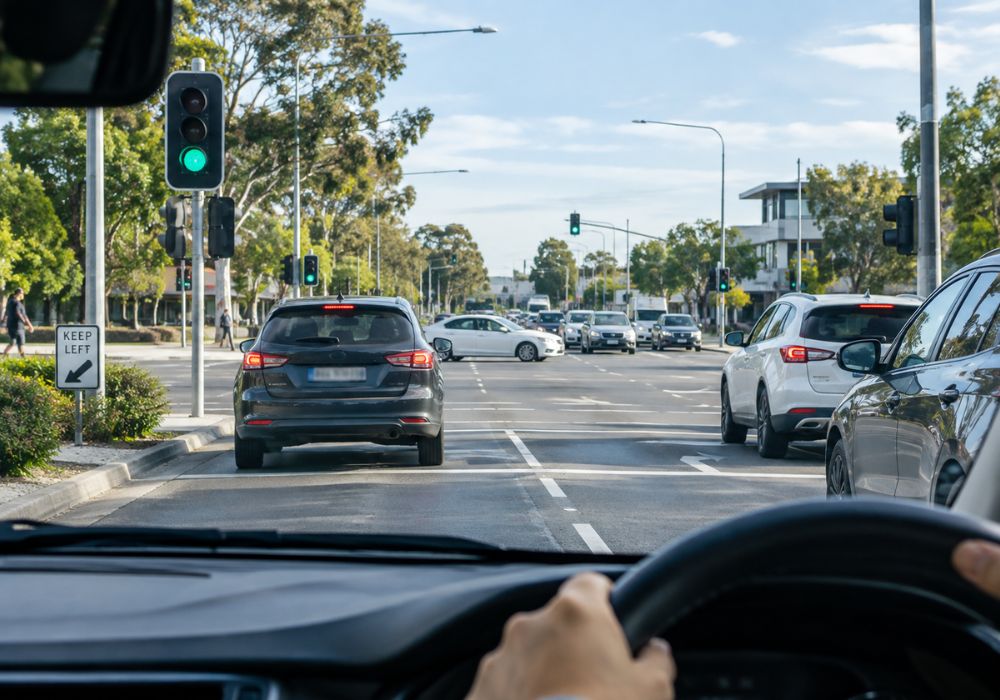
In Victoria, that difference matters. Transport Victoria’s traffic lights guidance says that on a green light you can go through the intersection if there’s enough room on the other side, and you must not stop or block the intersection. So the answer to the question is: only enter if you can clear it.
What the rule actually says
The Transport Victoria table sets out the basics:
| Signal | What to do |
| Red | Stop fully and don’t enter the intersection |
| Yellow | Stop unless it’s not safe to do so |
| Green | Go through if there’s enough room on the other side. Don’t stop or block the intersection |
The green light row has two parts. The first is a permission: you may go. The second is a condition: only if the exit is clear enough for you to get through. If it isn’t, you wait at the stop line, even though your light is green.
Why it matters
If you drive into an intersection and get stuck in the middle when the light changes, you block the cross traffic that now has a green. That causes a jam, and it puts you in the path of vehicles that have every right to be there. It also blocks pedestrians and, at some intersections, trams and buses.
There’s also a simple safety reason. A stationary car in the middle of an intersection is a collision waiting to happen, especially when drivers on the cross street are accelerating away from their own red.
How to check before you enter
Don’t just watch the car in front. Look further ahead, past the intersection, and ask whether there’s a space for your whole vehicle on the far side.
- Look at the exit lane. Is traffic moving, or is it queued back into the intersection?
- Judge the gap. You need enough clear road beyond the intersection to fit your car completely, not just your front wheels.
- Watch for buses, trams and trucks. A large vehicle ahead can hide the fact that the queue has stopped.
- Check for pedestrians on the far side. If people are crossing where you’re heading, you may not be able to clear the intersection.
- Keep a gap behind the car in front. Leave space so you’re not creeping forward into a space that isn’t really there.
If there’s any doubt, stop at the line. A few seconds of waiting costs far less than being stuck in the middle.
What if the queue moves on while you wait?
That’s fine. Your light might change to red before you get a chance to go, and that’s a normal outcome. It’s the price of not blocking the intersection, and drivers behind you will understand the delay better than they’ll understand a blocked crossroad.
Turning right on a green light
Turning right at an intersection without a green arrow is a common exception that confuses people. RACV explains that when turning right at lights without a dedicated arrow, drivers are allowed to enter the intersection on a green light and wait until oncoming traffic clears.
That’s a specific and legitimate way to wait in the intersection. It’s different from stopping there because the road ahead is jammed. You’re in position for a turn you can complete once the oncoming traffic gives you a gap. Also remember that, as Transport Victoria notes, you must always give way to pedestrians entering or crossing the road you’re turning into, whether or not the pedestrian lights are green.
Green arrows
If your light shows an arrow, follow the arrow that points in the direction you want to go. Transport Victoria says you can turn at a green arrow if it’s safe to do so, and you must stop at a red arrow. The same thinking applies: check that the road you’re turning into has space for you before you commit.
Other situations that catch drivers out
- Lights with a white T or B. These are for trams and buses. All other drivers must wait for the normal green lights or turning arrows.
- Bicycle symbol lights. These are for bicycle riders only. Other road users follow the normal signals.
- Lights not working or flashing yellow. Treat the intersection as if it has a stop or give way sign or line.
Mistakes to avoid
- Following the car ahead through on a stale green. Just because the driver in front went doesn’t mean you’ll clear it.
- Watching the light instead of the road. The signal is only half the picture.
- Stopping in the intersection “just for a moment”. Even a short stop can block cross traffic.
- Treating yellow as extra green. RACV describes a yellow light as the start of the red, not the end of the green. You should stop unless it’s unsafe to do so.
Where this fits in your learning
Good intersection judgement comes with practice, and supervised hours are where you build it. The Victorian learner logbook guide explains how those hours are recorded, and the beginner’s guide to getting a Victorian driver’s licence shows how the road rules fit into the wider licensing process. Once you hold your probationary licence, the P1 driver rules guide covers what to keep in mind.
FAQs
Can I be fined for blocking an intersection on a green light?
Transport Victoria says drivers can be fined and receive demerit points if caught breaking traffic light rules, and the green light rule says you must not stop or block the intersection. For the current penalty, check with Transport Victoria or VicRoads.
Does the rule apply if the light is green but traffic ahead is moving slowly?
Yes. The test is whether there is enough room on the other side for you to clear the intersection. If traffic is crawling and you can’t be sure you’ll get through, stay behind the stop line.
Where can I read the actual road rules?
The rules for traffic lights are published in the Road Safety Road Rules 2017. Transport Victoria lists the relevant section as Part 6, Obeying traffic lights (Rules 56 to 66).
What should I do if the lights are out?
If the traffic lights aren’t working, or if they’re flashing yellow, follow the same rules as at an intersection with a stop or give way sign or line.