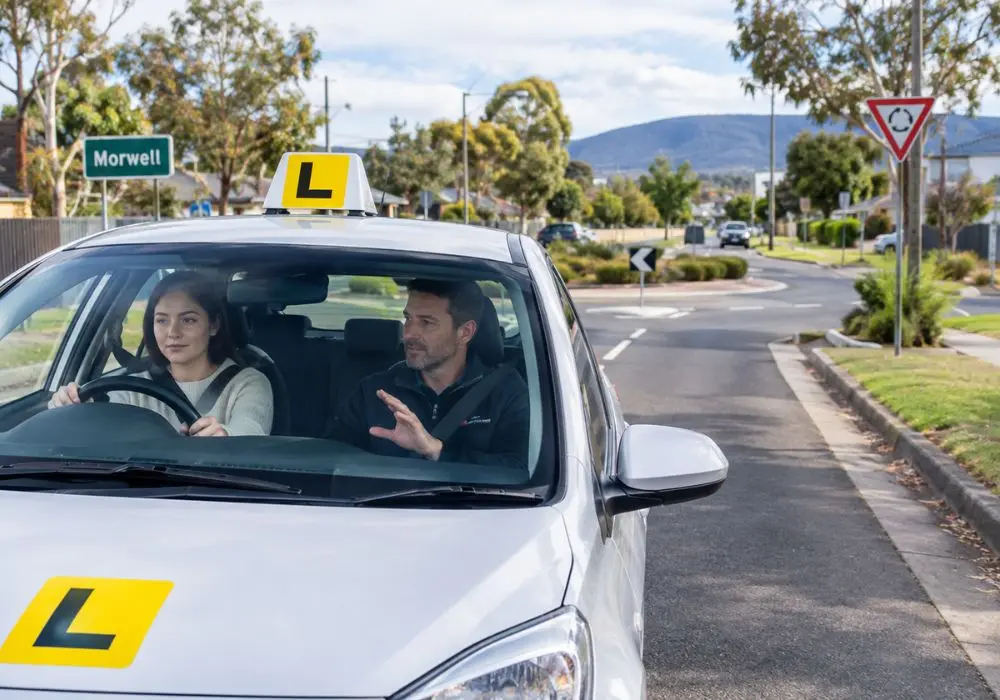
A driving test route isn’t a list of streets to learn. It’s a series of situations, and each one asks the same question: what do you need to observe and decide right here?
Practising around Moe helps because intersections, road layouts, parking areas and speed limit changes start to feel familiar. The aim is to sharpen your driving skills, not to memorise a sequence of turns. If you’d like structured help, our Moe driving lessons are built around exactly that approach.
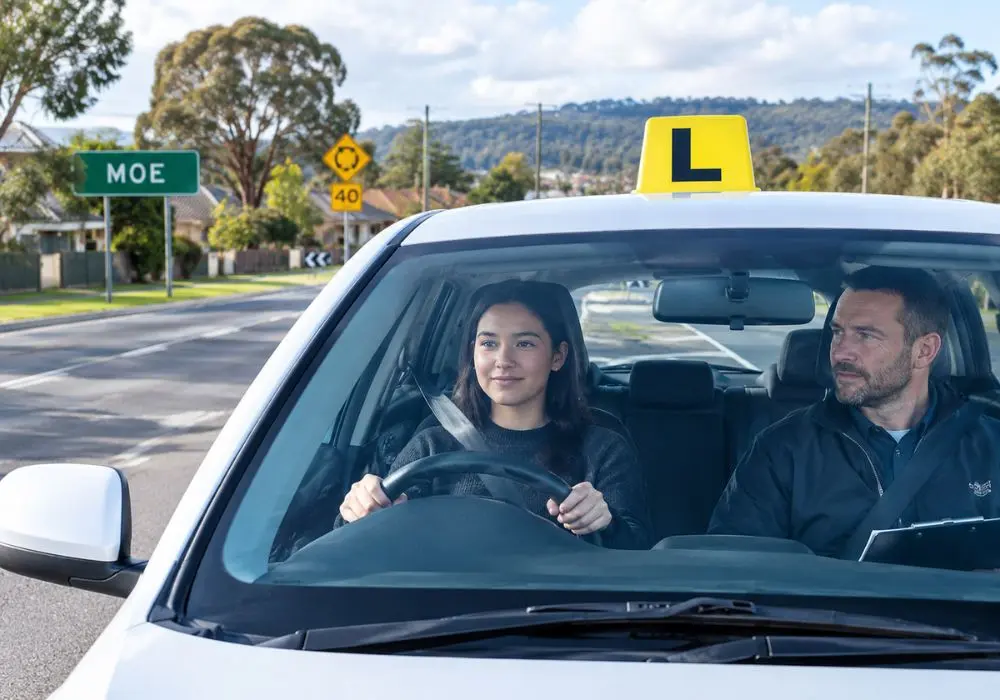
What Does the Moe Driving Test Route Involve?
No single sequence of streets makes up the test. The VicRoads drive test is a pre-drive check followed by two on-road stages, as explained in Transport Victoria’s drive test guide.
Stage 1 covers less challenging conditions and can include starting and stopping, left and right turns at intersections, lane changes and a low-speed parking manoeuvre. That manoeuvre is either a reverse parallel park or a three-point turn. Stage 2 adds busier traffic, lane changes, merging and driving on straight and curved roads.
Why Practise Around Moe Before Your Test?
Driving where you’ll be tested shows you how intersections are arranged, where visibility changes and how quickly traffic conditions shift. That familiarity should support your decisions, not replace them.
Knowing an intersection is coming doesn’t remove the need to check for pedestrians, cyclists and other vehicles. A familiar street doesn’t mean you repeat what you did last time, either. Ask “What do I need to observe and decide here?” instead of “What happens next on this route?”
The Main Skills to Practise on Moe Roads
Intersections and Giving Way
Intersections combine several skills at once. Approach at a suitable speed, check signs, markings, traffic and pedestrians, and finish the turn in the correct position. Practise at a range of intersections rather than one familiar junction, so you respond to what’s in front of you instead of what you remember.
Observation and Head Checks
Good observation is continuous. Check your mirrors regularly, scan ahead before changing direction or position, and know what’s around the car before you change lanes.
VicRoads assesses observation and signalling, and failing to look or signal can be recorded as a critical error, even where no other road user has to take evasive action. The details are set out in the VicRoads drive test criteria for instructors. If you’re busy remembering the next street, you have less attention for what’s actually happening around you.
Lane Changes and Road Position
Make lane changes deliberate. Assess the traffic, check your mirrors and blind spot, signal and move only when it’s safe. Keep your road position appropriate as you approach turns, intersections and changes in traffic flow. Practising on different roads prepares you for changing traffic instead of one predictable situation.
Speed Management
The posted limit is only part of speed control. Consider visibility, traffic, road conditions and hazards. Driving too fast cuts the time you have to respond, and driving unnecessarily slowly can also count against you when conditions allow normal progress. VicRoads lists speed choice among the assessed areas, so notice how smoothly you adjust your speed, not just whether you’re under the limit.
Parking and Low-Speed Manoeuvres
Practise until you can complete the manoeuvre while keeping proper observation and vehicle control. Your starting position, the space available and nearby vehicles will differ each time, so learn how the car moves instead of memorising a steering pattern. If parking still feels inconsistent, automatic driving lessons can give you extra practice with vehicle control and low-speed manoeuvres.
Why Memorising a Moe Test Route Is Not Enough
VicRoads’ criteria separate assessable driving tasks from the linking manoeuvres that connect them into a continuous route. They also allow tasks to be performed in different places and, in some circumstances, one task to be replaced by another.
In practice, you need to handle a situation even when it doesn’t appear where you expected. Knowing how to respond to an unfamiliar intersection, unexpected traffic or a different parking position is worth more than knowing what to do at one familiar spot.
How to Use Local Route Practice Properly
Skip the repeated laps of one route and give each session a job. Spend one on intersections and observation, another on lane changes and busier traffic, and another on parking, speed control and directions you haven’t heard in advance.
Try narrating your decisions out loud as you drive, for example “cyclist ahead, checking mirror, easing off.” If you can’t explain a decision, you probably made it on autopilot.
Vary the roads too. Practising in Moe and then in nearby Morwell or Traralgon stops your habits depending on one environment.
What Should You Do in the Final Weeks Before the Test?
Focus on consistency rather than new techniques. Note the mistakes that keep appearing in ordinary driving, such as a missed head check, approaching intersections too quickly, hesitating over a gap or losing composure while parking. Those are the areas that need extra practice.
Do some drives without being told what’s coming, so you can show you can read signs, traffic and instructions independently. If it’s been a long time since you last drove, refresher driving lessons may help before you start focused test preparation.
What to Check Before Test Day
The practical requirements deserve as much attention as your driving. VicRoads currently requires learners to have passed the Hazard Perception Test and, where applicable, completed and declared 120 hours of supervised driving. The full steps are in the VicRoads guide on how to get your Ps. You also need an eligible vehicle, and VicRoads doesn’t provide one.
The vehicle must meet specific requirements, including registration, working lights, appropriate mirrors, seatbelts and a visible speedometer. If you need a car for the appointment, car hire for the driving test is worth checking ahead of time, and you can compare costs on our pricing page. When you’re ready, book your drive test on the VicRoads website. VicRoads also advises arriving 15 minutes early.
How Do You Know When You Are Ready?
You don’t need to drive a familiar route perfectly. Consistency across everyday situations is a better sign. You should be observing properly before making decisions, handling intersections without prompts, selecting safe gaps, changing lanes with proper observation and signalling, and keeping a speed and road position that suit the conditions. You should also be completing the parking manoeuvre under control, following the testing officer’s instructions, and adapting when traffic or road conditions aren’t what you expected.
These should be part of your normal driving, not things you only remember during the test.
Frequently Asked Questions
What does VicRoads assess during the drive test?
VicRoads assesses observation, signalling, gap selection, speed choice, following distance, lateral position, stopping position, parking and vehicle control.
What if the testing officer’s directions take me somewhere I haven’t practised?
That’s normal. VicRoads assesses tasks and behaviours, not your knowledge of particular streets, and its criteria allow some variation in where tasks happen. Listen to the instruction, observe and decide as you would on any road.
Does driving slowly count in my favour?
Not necessarily. Driving unnecessarily slowly can be assessed negatively when conditions allow normal progress. Aim for a speed that suits the traffic, visibility and road conditions.
What should I practise if I’m nervous about the Moe test?
Start with the situations that make you most uncertain, such as intersections, lane changes, parking or busier traffic. Repeating them in different locations helps your responses become more consistent.