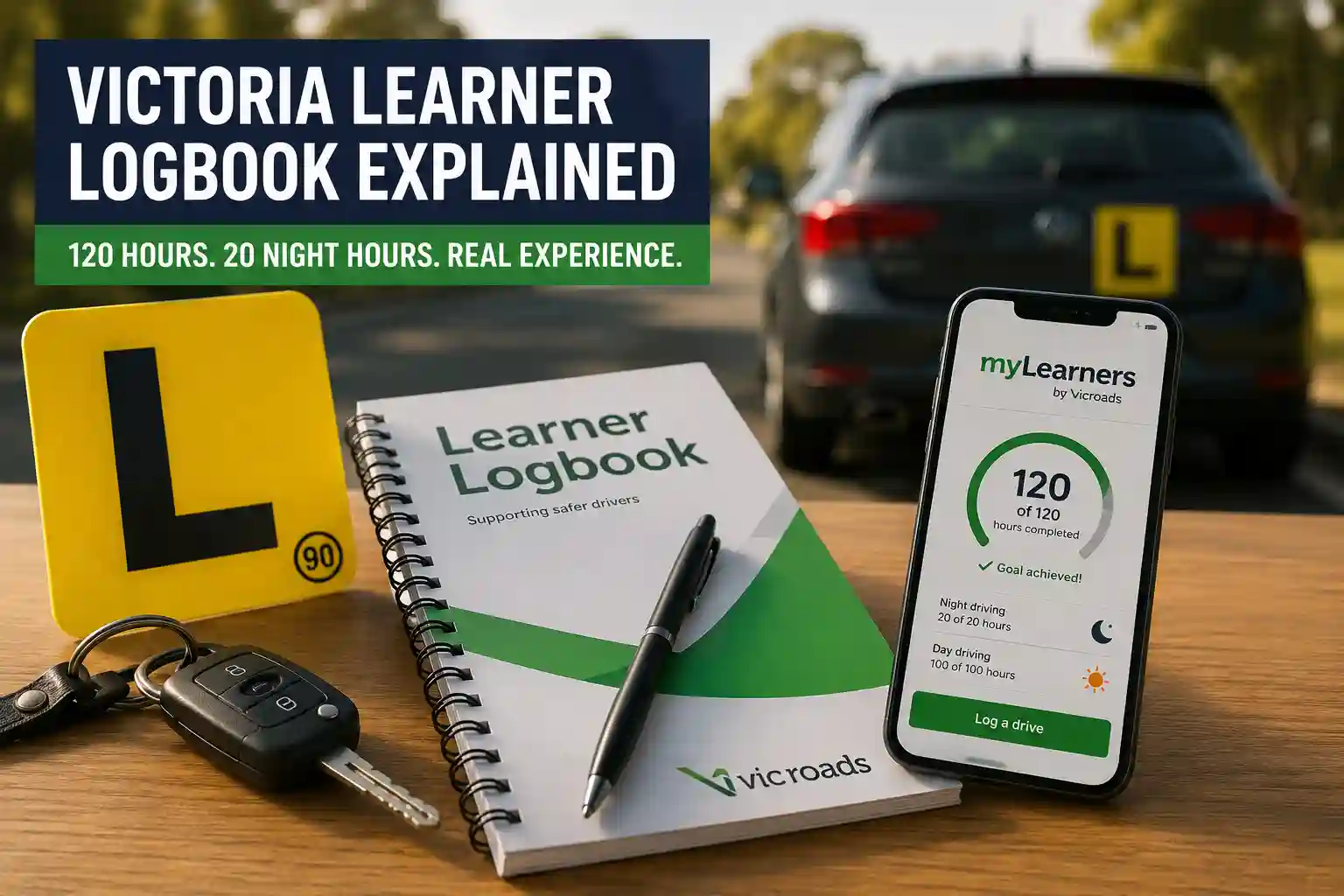
If you’re under 21 and want your Victorian probationary licence, you must complete at least 120 hours of supervised driving, including 20 hours of night driving, and record every session in the official VicRoads learner logbook or the myLearners app.
What Is the Victoria Learner Logbook?
The Victoria learner logbook is an official record of your supervised driving experience. It shows that you have completed the required practice before taking your VicRoads drive test.
The idea is to make sure every young driver gets real experience across different roads and conditions before they’re out there alone. Before driving independently, it’s also important to understand the P1 driver rules in Victoria that apply once you pass your driver’s test.
Why the Logbook Is Required
Transport Victoria research shows that new drivers with at least 120 hours of supervised experience have a crash risk around 35% lower than those with only 50 hours. The hours make a real difference to your safety once you’re driving alone.
Paper Logbook vs myLearners App
You have two options for recording your hours.
The paper logbook comes with your learner kit when you pass the learner permit test at a VicRoads Customer Service Centre. Every entry must be handwritten in pen: the date, start and finish times, distance driven, road conditions, and your supervisor’s signature.
The myLearners app is VicRoads’ free official digital option, available on both iOS and Android. It uses GPS to track each drive automatically and calculates your day and night hours separately. Your supervisor approves each session through the app or their myVicRoads account.
Quick Facts on Victoria Learner Logbook
| Requirement | Detail |
| Who must complete it | Most learner drivers under 21 |
| Total supervised hours | Minimum 120 hours |
| Night driving hours | Minimum 20 hours |
| Minimum learner permit period | 12 months (under 21) |
| How to log hours | myLearners app or official paper logbook |
| When it’s checked | Before your VicRoads drive test |
How Many Driving Hours Are Required?
Eligible learner drivers must record at least 120 hours of supervised driving, including a minimum of 20 hours of night driving.
Day Driving Hours
Your day hours make up the bulk of your logbook. The remaining hours, beyond your 20 night sessions, can be completed at any time during the day. There’s no maximum. Many learners aim for 130 or more to build extra confidence before the drive test.
Night Driving Hours
Night driving is defined as any driving that takes place between sunset and sunrise, not a fixed clock time. Sunset and sunrise shift with the seasons, which means the myLearners app automatically calculates night hours based on actual sunrise and sunset times for that date.
If you’re using the paper logbook, record the exact start and finish times so VicRoads can verify the entry correctly.
A minimum of 20 hours must be night driving. Learner permits issued before 1 November 2017 only required 10 hours of night driving, but all permits issued after that date require 20 hours.
Minimum Learner Permit Holding Period
Completing 120 hours early does not mean you can book your drive test right away. Under-21 learners must hold their permit for a full 12 months and pass the Hazard Perception Test, which requires you to be at least 17 years and 11 months old.
Why Driving Variety Matters
Unlike New South Wales, where learners can log up to 20 bonus hours through a 3-for-1 scheme with professional instructors, Victoria requires all 120 hours to be genuine, one-for-one supervised driving time.
VicRoads looks at more than just your total. If your entries all show the same short local route with no variation in road type or conditions, you may tick the hour box but still struggle in the drive test.
Who Needs to Complete a Learner Logbook?
Most learner drivers under 21 must complete 120 supervised driving hours and record them before they can take the VicRoads drive test. Different requirements apply to some drivers aged 21 and over.
Learner Drivers Under 21
If you’re under 21 when you apply for your probationary licence, the logbook is mandatory. You must record a minimum of 120 hours, including the 20 hours of night driving described above. You must also hold your learner permit for at least 12 continuous months before you can sit the drive test.
Learner Drivers Aged 21 and Over
If you’re 21 or over, there’s no minimum hour requirement, and the logbook is not compulsory. However, the minimum permit holding period still applies:
- Ages 21 to under 25: hold your learner permit for at least 6 months before the drive test
- Ages 25 and over: hold your learner permit for at least 3 months before the drive test
Even if you’re over 21 and not required to log hours, more supervised practice means better skills before you’re driving alone.
Interstate and Overseas Licence Holders
If you move to Victoria and hold an interstate or overseas learner permit, you may need to convert to a Victorian learner permit. If you’ve previously completed supervised hours in another state or country, some of those hours may count toward the Victorian requirement.
Who Can Supervise a Learner Driver?
Supervisor Eligibility
To supervise a learner driver in Victoria, the person must:
- Hold a full, current, non-probationary Victorian driver’s licence, or a current interstate or overseas equivalent
- Sit in the front passenger seat throughout the entire drive
- Have a blood alcohol concentration (BAC) below 0.05 while supervising
- Carry their licence while supervising
A supervisor can hold licence restrictions such as automatic transmission or hand controls and still supervise, provided they follow their own licence conditions.
You can have multiple supervisors. The myLearners app allows you to link an unlimited number of supervising drivers to your account, and each one can approve drives independently.
Supervisor Responsibilities
The supervisor is legally responsible for confirming that every logbook entry is accurate. Providing false or misleading information in the logbook is an offence under the Road Safety Act 1986. Penalties include fines and the potential reversal of any licence obtained as a result.
Tips for Parents and Supervisors
Give clear instructions before each drive, not during. Talking over hazards mid-corner increases stress and reduces your learner’s focus.
Debrief after each session instead. That way your learner can reflect calmly on what happened.
Also, RACV notes that parents who join their learner for a lesson or two with a professional instructor, sitting in the back seat, often become much more effective supervisors. Watching a professional demonstrate feedback techniques can significantly reduce stress for both of you.
If you do not have access to a supervising driver or a suitable vehicle, the TAC L2P Program can help. It matches eligible Victorian learners aged 16 to 21 (and in some cases up to 23) with a fully licensed volunteer mentor and a funded vehicle.
The program is free and delivered by councils and community agencies across Victoria. Apply through your myVicRoads account.
What Should You Practise During Your 120 Hours?
Your supervised driving should include a wide range of road types, traffic conditions, weather, and parking situations to prepare you for independent driving.
Residential Streets
Start here. Low-speed environments help new learners build confidence with steering, observation, and road rules before adding complexity. Practise giving way at intersections and consistently checking mirrors.
Busy Urban Roads
Melbourne’s inner suburbs and CBD-adjacent corridors, such as Chapel Street, Punt Road, or Sydney Road, are ideal for practising lane changes, heavy traffic, and pedestrian crossings. Urban driving requires fast decision-making. Build up to it gradually.
Highways and Freeways
Freeway driving teaches merging, maintaining speed, and identifying exit lanes early. The Eastern Freeway and Western Ring Road are common training routes for Melbourne learners. Aim to complete these during lower-traffic periods initially, then progress to peak-hour conditions.
Roundabouts and Intersections
Victoria has a high density of roundabouts, particularly in outer metropolitan areas. Practice giving way correctly, signalling, and timing entry without stopping unnecessarily. Multi-lane roundabouts, such as those in Doncaster or Frankston, are worth practising on before your drive test.
Parking Manoeuvres
Parallel parking, reverse parking, and angle parking all appear in VicRoads drive tests. Set aside at least a few sessions specifically for parking practice in quiet streets before attempting busier locations.
Wet Weather and Night Driving
Wet roads reduce braking distance significantly. Practice in light rain before driving in heavy rain, and always increase following distance. For your 20 compulsory night hours, try to include sessions in both well-lit suburban streets and darker roads, so you experience genuine low-visibility conditions.
Practical Tips to Complete Your 120 Hours
Planning regular practice sessions throughout the year makes it easier to complete your required hours while steadily improving your driving skills.
Create a Weekly Driving Schedule
At two to three hours of supervised driving per week, you’ll reach 120 hours in around 10 to 12 months. That fits neatly within the 12-month minimum permit period if you start consistently from day one. Map out regular sessions in advance so they don’t slip.
Drive in Different Conditions
Your 120 hours are most useful when you treat them as structured practice across different environments, not just hours to count off.
VicRoads and the myLearners website publish a skills checklist you can use to make sure you’re covering the range of environments expected at the drive test.
Use Professional Driving Lessons
Professional lessons with a licensed driving instructor count as one hour each in your logbook. If you’re still deciding which vehicle to learn in, it’s worth comparing automatic and manual driving lessons before you commit.
Instructors teach the specific hazard awareness and manoeuvre techniques that come up in the drive test. Two or three lessons early on to build the right habits, then another session or two in the weeks before your test, works well for most learners.
Track Your Progress Regularly
The myLearners app shows your running totals at a glance. Check in weekly so you know if your night hours are falling behind before it becomes a last-minute problem. Don’t leave the 20 night hours until the final month.
Prepare Early for the Drive Test
You must pass the Hazard Perception Test before you can book your drive test. You need to be at least 17 years and 11 months old to sit the test.
The first online attempt is free through your myVicRoads account. Plan to sit it at least a few weeks before your intended drive test date, so a failed first attempt doesn’t delay your booking.
Drive test appointments at VicRoads Customer Service Centres book out quickly, especially in Melbourne. Start looking at availability at least four to six weeks before you plan to sit.
All information in this article is sourced from VicRoads, Transport Victoria, and the TAC. Requirements can change, so always confirm the latest rules directly with Transport Victoria before booking your test.