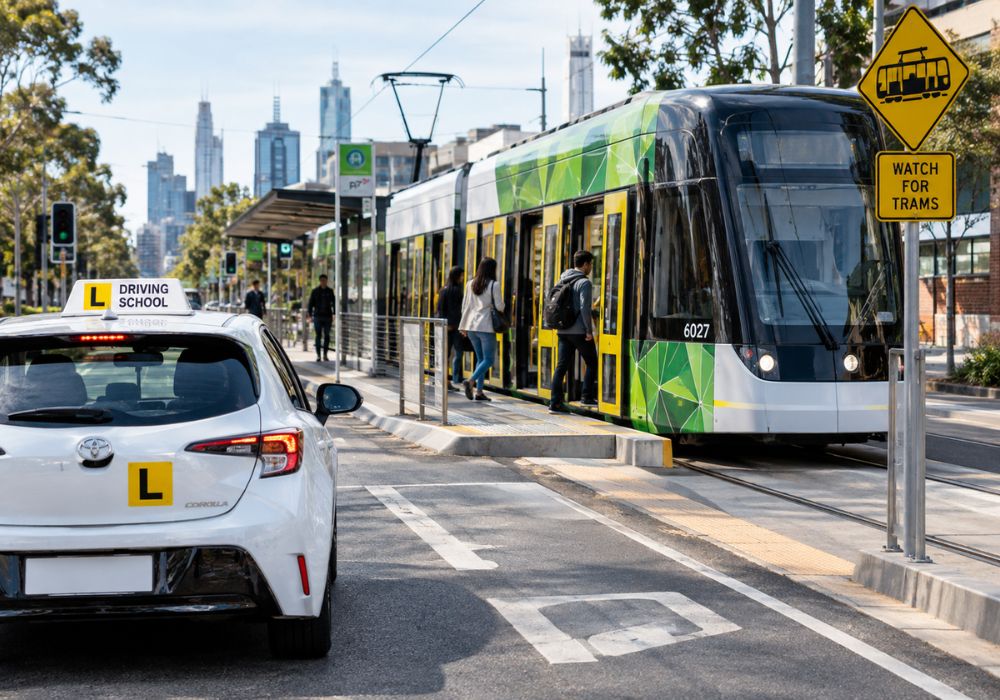
If a tram stops at a roadside stop and its doors open, you must stop behind the back end of the tram. You can’t drive past it while passengers are getting on or off.
That’s the short answer, and it covers most situations. The detail that trips people up is when you’re allowed to go again, and what changes when there’s a safety zone. This guide covers both.
The rule in plain terms
Transport Victoria’s driving with trams guidance says you must stop behind trams at roadside tram stops, and your vehicle must not pass the back end of the tram. You then wait until the doors close and all pedestrians have finished crossing.
So there are two conditions, and both must be met before you move:
- The tram doors are closed.
- The road is clear of pedestrians.
If the doors have shut but someone is still crossing, you keep waiting. If the road looks clear but the doors are still open, you also keep waiting.
Why the rule exists
At a roadside stop without a platform, passengers step straight off the tram onto the road. They’re crossing lanes that cars are travelling in, often while looking at the tram, their phone or the footpath. Stopping behind the tram gives them a protected path to the kerb, and it keeps you from driving into someone you can’t see.
Passengers also run for trams. Transport Victoria warns drivers to watch for pedestrians who appear at the last minute and rush to catch one. That’s another reason to wait until the road is properly clear, not just for a gap.
Where exactly to stop
Stop at the rear of the tram, not beside it and not partway along. Your car should not go past the back end.
A few practical habits help:
- Leave a little room. Stopping right on the tram’s tail leaves you no space if someone steps out from behind it.
- Stay put. Don’t creep forward as passengers step off. Creeping is how cars end up level with an open door.
- Keep your foot on the brake. You may be waiting a while, and a rolling car near pedestrians is a risk.
- Watch the mirrors. Traffic will be stopping behind you, so brake smoothly.
When you can go again
Once the doors are closed and the road is clear of pedestrians, Transport Victoria says you may drive past the stopped tram at 10 km/h. That speed limit applies while you pass the tram, so ease by slowly and stay ready to stop.
Don’t treat the door closing as a green light on its own. A tram that has just closed its doors may still have people walking away from it. Check first.
What changes at a safety zone
Some tram stops have a safety zone, which is a protected area for passengers. Where there is one, the rule is different. Transport Victoria says you can drive past the tram at a safe speed, keeping to the left of the safety zone.
The reason is that passengers there are already separated from moving traffic. You still need to watch for pedestrians, but you aren’t required to stop behind the tram in the same way.
If you can’t clearly see a safety zone, assume there isn’t one and stop behind the tram. Working out the difference in a hurry is easier once you’ve seen a few stops in real traffic, so it’s worth noticing them from the passenger seat as well as the driver’s seat.
Quick reference
| Situation | What you do |
| Tram stops at a roadside stop, doors open, no safety zone | Stop behind the tram’s rear end and wait |
| Doors closed, pedestrians still crossing | Keep waiting |
| Doors closed, road clear of pedestrians | Pass at 10 km/h or less |
| Tram stopped at a safety zone | Pass at a safe speed, to the left of the safety zone |
Common mistakes
- Stopping level with the tram. The rule is behind the rear, not alongside.
- Going the moment the doors shut. Pedestrians may still be crossing.
- Passing too fast. The limit while passing is 10 km/h.
- Assuming every stop has a safety zone. Check before you drive past.
Where this fits in your learning
Trams are a Melbourne-specific skill, and one that learners from regional areas or overseas often meet for the first time when they drive in the city. The Victorian learner logbook guide explains how supervised hours are recorded, and it’s worth using some of them in varied conditions. The beginner’s guide to getting a Victorian driver’s licence shows where road rules sit in the wider process, and the P1 driver rules guide covers what changes once you have your probationary licence. If you hold an overseas licence, our page on overseas licence conversion explains how your licence transfers to Victoria.
FAQs
Can I go around the tram if there’s a gap in traffic?
No. Without a safety zone, you must stay behind the tram while its doors are open, and you can only pass once the doors are closed and the road is clear of pedestrians.
What speed can I drive past a stopped tram?
At 10 km/h, once the doors are closed and the road is clear of pedestrians. At a safety zone, you can drive past at a safe speed, to the left of the zone.
How do I know if a stop has a safety zone?
A safety zone is a protected area for passengers at the stop. If you can’t see one clearly, treat the stop as having none and stop behind the tram.
Does the rule apply if only one door is open?
Transport Victoria’s guidance refers to passengers getting on or off at roadside stops. If any doors are open and people may be crossing, wait until all doors are closed and the road is clear.