You spot a car sitting at a side street, tap the response button straight away, and the practice test tells you that you responded too early. You noticed the hazard before anyone else would have. So why is that wrong?
It trips up more learners than almost any other part of the Hazard Perception Test (HPT). The short answer is that the HPT is not testing whether you can spot things. It is testing whether you respond at the right moment.
What the HPT Actually Measures
The Victorian HPT shows you 25 driving scenarios filmed from the driver’s seat, and you have 45 minutes to work through all of them. In each clip you decide whether to respond and when.
What the test compares your answer against is what a safe, experienced driver would do in that situation. Not the fastest driver. The appropriate one.
There is a real difference between noticing a risk and acting on it. Noticing a parked van near a school is good awareness, but braking hard for it when nothing has changed is not a safe response.
On a real road, that kind of early braking surprises the driver behind you and can cause the very incident you were trying to avoid.
Potential Hazard vs Developing Hazard
Nearly every early click traces back to confusing these two stages.
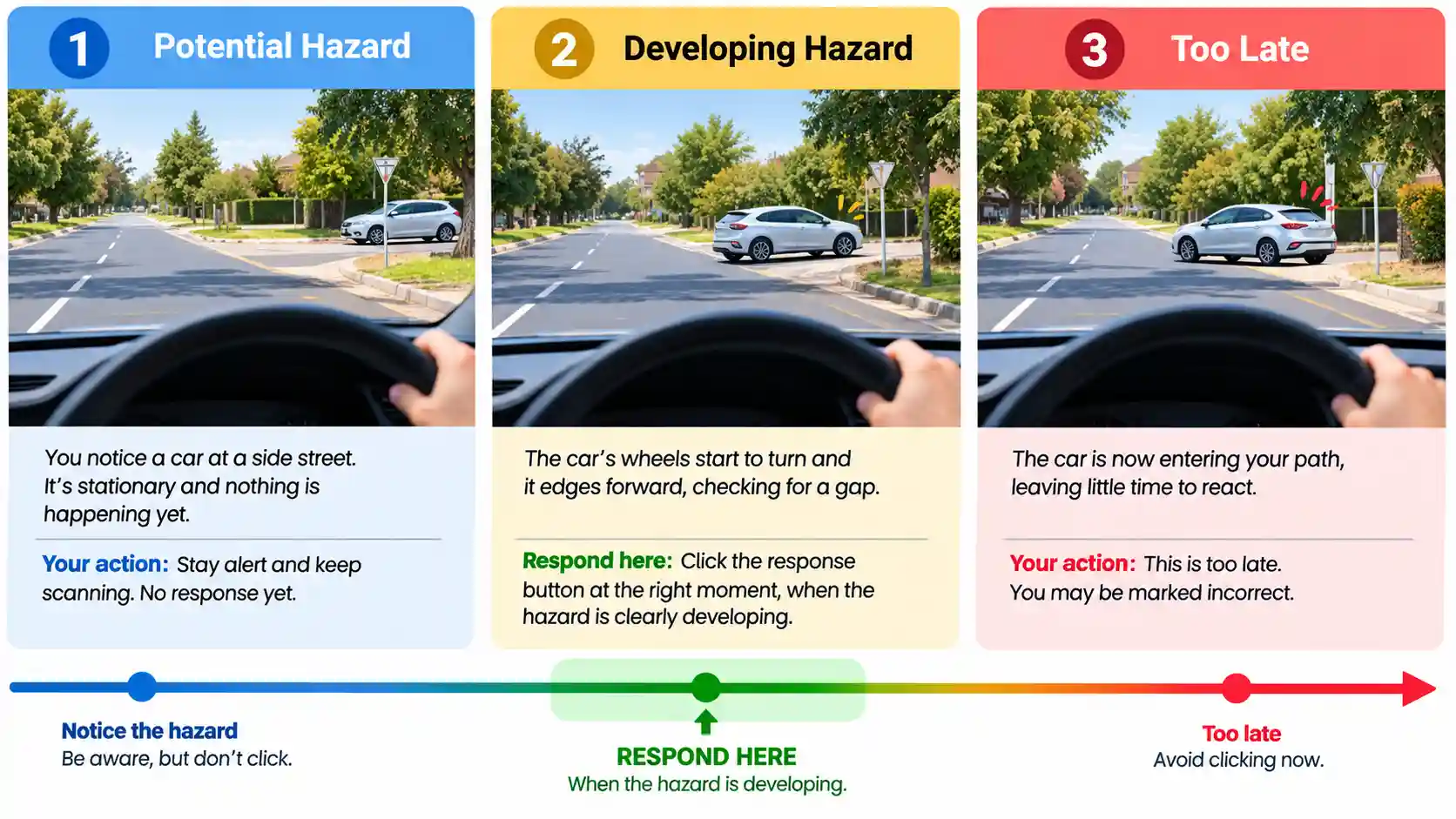
A potential hazard is anything that could cause a problem. A parked van, a group of kids near the footpath, a driveway hidden behind a fence. Scan for them and stay ready, but they do not need a response yet.
A developing hazard is the moment that potential turns into something you have to act on. The kids step toward the kerb. The driver at the side street starts rolling forward. A brake light comes on three cars ahead and traffic begins to bunch up.
The response window sits on the developing hazard. Click during the potential stage and you are too early. Leave it until the hazard has already forced your hand and you are too late. Both are marked incorrect.
| Potential hazard | Developing hazard | |
| Meaning | Could become a problem | Now needs action |
| Children | Standing on the footpath | Moving towards the road |
| Car | Waiting at a side street | Moving into your path |
| Traffic | Flowing normally | Braking and slowing ahead |
| Your job | Watch and stay ready | Respond |
Take the side street example that learners complain about constantly in Australian driving forums. The car is stationary, wheels not turning, driver not looking your way. Nothing has changed, so there is nothing to respond to yet.
The developing hazard is the car’s wheels starting to turn, the driver’s head swinging round to check for a gap, or the nose of the car edging out. That is your trigger, not the car simply being there.
Why This Matters on a Real Road
The test is built around a principle you will use for the rest of your driving life. If you slowed or braked every time you saw something that could theoretically become a problem, you would create hazards of your own.
Experienced drivers handle it in stages. They notice the potential hazard early, move their attention to it, maybe ease off the accelerator or cover the brake, and save the firm response for the moment the situation genuinely changes.
Here is another example learners raise often: a country road with a dirt side road up ahead. Some click “slow down” the second the side road appears. The correct response comes later, when a vehicle actually appears at the junction or dust rises to suggest something is coming.
Some Scenarios Need No Response at All
In a number of clips, the right answer is to do nothing. The practice tests give you feedback on both your action and your non-action, which means sitting tight and letting a scenario play out can be the correct call.
Fall into a rhythm of clicking in every clip and you will be marked wrong on those ones. Treat each scenario as its own question: does anything here actually require me to change what I am doing right now?
Learners who have worked through the practice set often say the harder skill was learning when not to click.
How Timing Is Judged
VicRoads does not publish the exact timing window for each scenario, so nobody can hand you a precise number of seconds.
Be wary of any site or app claiming to have worked out exact click times, particularly ones built around the UK hazard perception test. That test uses a sliding scale where earlier scores higher. The Victorian test does not work that way. Early is wrong, late is wrong, and there is a correct window in between.
A rule of thumb that comes up repeatedly in Australian learner communities: think about where your car would be in relation to the hazard. Several car lengths away with nothing changed and you are probably early. Close enough that stopping safely is already difficult and you are late.
What Triggers a Correct Response
Rather than trying to memorise timing, train yourself to spot the change in each clip. The signs a situation is shifting from potential to developing include:
- Wheels turning on a car waiting at a side street
- A pedestrian stepping off the kerb rather than standing on it
- A driver’s head turning to check for a gap
- Brake lights coming on ahead
- A ball rolling onto the road, since a child may follow it
- A vehicle reversing out of a driveway
- A cyclist wobbling or glancing over their shoulder before moving across
The trigger is always a change in behaviour. Static things, like parked cars, a bend in the road, or an intersection you are approaching, are not triggers on their own.
Practising Without Training Yourself to Click Early
VicRoads offers nine free practice tests that mirror the real thing. Results are not saved, so you can repeat them as often as you like, and on a PC you can respond with the space bar instead of the button.
The useful habit is to stop on every “too early” result and ask what you actually saw versus what had not happened yet. Then replay the clip and find the exact frame where the situation changed. That frame is your trigger point.
Watch out for memorisation. Once you know a clip, your score reflects recall rather than hazard perception, so a strong practice score after several run-throughs may be flattering you.
Plenty of learners also click early out of nerves rather than misjudgement, knowing full well they are jumping the gun and tapping anyway. If that is you, slow your scanning down on purpose, take in the whole scene, and commit to waiting for a change before you respond. It helps to remember that the test is not punishing you for seeing things late, only for acting before the situation calls for it.
Real driving is where this judgement gets built. Ask your supervising driver or instructor to call out potential hazards as you drive and talk through the point at which each one would become a developing hazard.
Learners who find the whole process stressful often get more out of structured sessions than extra solo hours, which is part of what nervous driver lessons are built around. For how supervised hours are recorded and counted, see our guide to the Victorian learner logbook.
Where the HPT Fits in the Licensing Process
You must pass the HPT before you can sit the VicRoads drive test.
HPT results are valid for 12 months. If you do not pass your drive test within 12 months of passing the HPT, you have to sit the HPT again before you can attempt the drive test. The 12 months is a time limit on the result itself, not a penalty for failing anything.
You can take the test online through your myVicRoads account, with two attempts allowed in one day, or in person at a VicRoads Customer Service Centre. Some overseas licence holders converting to a Victorian licence also need to complete it.
Once you pass the drive test, the rules for P1 drivers in Victoria are the next thing worth reading. For the full path from learner permit to Ps, our beginner’s guide to getting a Victorian driver’s licence covers each step.
Frequently Asked Questions
How many scenarios are in the Victorian HPT?
There are 25 driving scenarios and you have 45 minutes to respond to all of them. Run out of time before you finish and the attempt is recorded as unsuccessful.
Can I take the HPT online?
Yes. The online version runs through your myVicRoads account and you can attempt it twice in one day. It is also available in person at a VicRoads Customer Service Centre.
Is an early click always marked wrong?
Yes. Responding before the situation has developed enough to need action is recorded as an incorrect response, the same as clicking too late or not clicking when you should have.